Product Details
Product Information
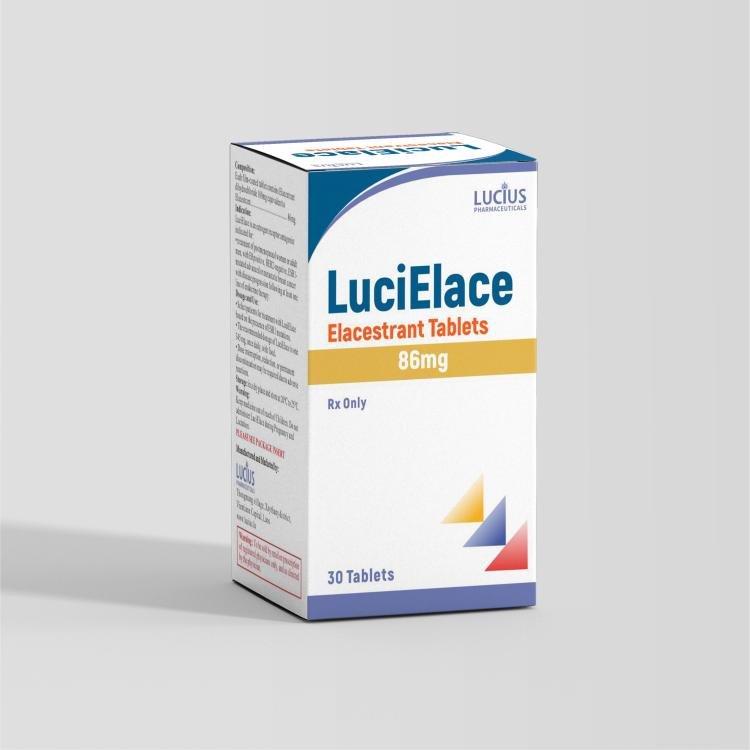
- Product name: LuciElace Elacestrant 86mg
- Manufacturer / brand: Laos Lucius Pharma
- Active ingredient: Elacestrant
- Current strength: 86mg
- SKU: LU-ITEM-161
- Site category: ESR1 target, other cancer
Product Summary
LuciElace Elacestrant 86mg is an AISTIKA-listed product supplied by Laos Lucius Pharma. This page summarizes the product identity, strength, SKU, site category, and public medical reference information. Product name, manufacturer, packaging, and strength follow this AISTIKA product page.
Active Ingredient and Reference Data
Elacestrant is the active ingredient used for this product page. Public prescribing information for Elacestrant was used for the medical reference sections. Medical details are provided for reference and must be interpreted by a qualified healthcare professional.
Mechanism of Action
Elacestrant is an estrogen receptor antagonist that binds to estrogen receptor-alpha (ERα). Elacestrant demonstrated in vitro and in vivo antitumor activity including in ER+ HER2- breast cancer models resistant to fulvestrant and cyclin-dependent kinase 4/6 inhibitors and those harboring estrogen receptor 1 gene ( ESR1 ) mutations.
Reference Indications
Elacestrant is indicated for the treatment of postmenopausal women or adult men with estrogen receptor (ER)-positive, human epidermal growth factor receptor 2 (HER2)‑negative, ESR1 -mutated advanced or metastatic breast cancer with disease progression following at least one line of endocrine therapy. Elacestrant is an estrogen receptor antagonist indicated for: treatment of postmenopausal women or adult men, with ER-positive, HER2-negative, ESR1 -mutated advanced or metastatic breast cancer with disease progression following at least one line of endocrine therapy
Reference Dosage and Administration
Recommended dosage of Elacestrant is one 345 mg tablet taken orally, once daily, with food Dose interruption, reduction, or permanent discontinuation may be required due to adverse reactions.
Dose conversion must be confirmed by a physician because the reference dose may vary by indication, organ function, toxicity, or interacting medicines.
This reference dosage is not an individualized prescription. Dose changes, treatment interruptions, or discontinuation must be directed by a physician.
Important Safety Information
Dyslipidemia: Elacestrant may cause hypercholesterolemia and hypertriglyceridemia. Monitor lipid profile prior to starting treatment and periodically thereafter. Embryo-Fetal Toxicity: Elacestrant can cause fetal harm. Advise of the potential risk to a fetus and to use effective contraception. ( 5.2 , 8.1 , 8.3 ) 5.1 Dyslipidemia Hypercholesterolemia and hypertriglyceridemia occurred in patients taking Elacestrant at an incidence of 30% and 27%, respectively. The incidence of Grade 3 and 4 hypercholesterolemia and hypertriglyceridemia were 0.9% and 2.2%, respectively . Monitor lipid profile prior to starting and periodically while taking Elacestrant.
Common Adverse Reactions and Monitoring
The safety of Elacestrant was evaluated in 467 patients with ER+/HER2- advanced breast cancer following CDK4/6 inhibitor therapy in EMERALD, a randomized, open-label, multicenter study . Patients received Elacestrant 345 mg orally once daily (n=237) or standard of care (SOC) consisting of fulvestrant or an aromatase inhibitor (n=230). Among patients who received Elacestrant, 22% were exposed for 6 months or longer and 9% were exposed for greater than one year. Permanent discontinuation of Elacestrant due to an adverse reaction occurred in 6% of patients. Dosage interruptions of Elacestrant due to an adverse reaction occurred in 15% of patients.
Drug Interactions and Special Populations
Strong and Moderate CYP3A4 Inducers : Avoid concomitant use with Elacestrant Strong and Moderate CYP3A4 Inhibitors : Avoid concomitant use with Elacestrant 7.1 Effect of Other Drugs on Elacestrant Strong and Moderate CYP3A4 Inhibitors Avoid concomitant use of strong or moderate CYP3A inhibitors with Elacestrant. Elacestrant is a CYP3A4 substrate. Strong and Moderate CYP3A4 Inducers Avoid concomitant use of strong or moderate CYP3A inducers with Elacestrant. Elacestrant is a CYP3A4 substrate. Concomitant use of a strong or moderate CYP3A4 inducer decreases elacestrant exposure , which may decrease effectiveness of Elacestrant. Elacestrant is a P-gp inhibitor. Elacestrant is a BCRP inhibitor. Lactation : Advise not to breastfeed. Hepatic impairment : Avoid use in patients with severe hepatic impairment (Child-Pugh C).
Storage and Purchase Notes
Store according to the package or pharmacist instructions and keep out of reach of children. Before ordering, confirm product name, strength, quantity, price, shipping details, and payment method. After receipt, check packaging, batch number, expiration date, and storage conditions.
Sources
Sources: ORSERDU public prescribing information; openFDA/DailyMed public label data. These sources are used for public medical reference. Product information follows this AISTIKA product page.
DisclaimerProduct details, availability, pricing, and checkout information can change. Please review this product page carefully and consult a qualified healthcare professional before using any medicine.
Reviews
There are no reviews yet.