Product Details
Product Information
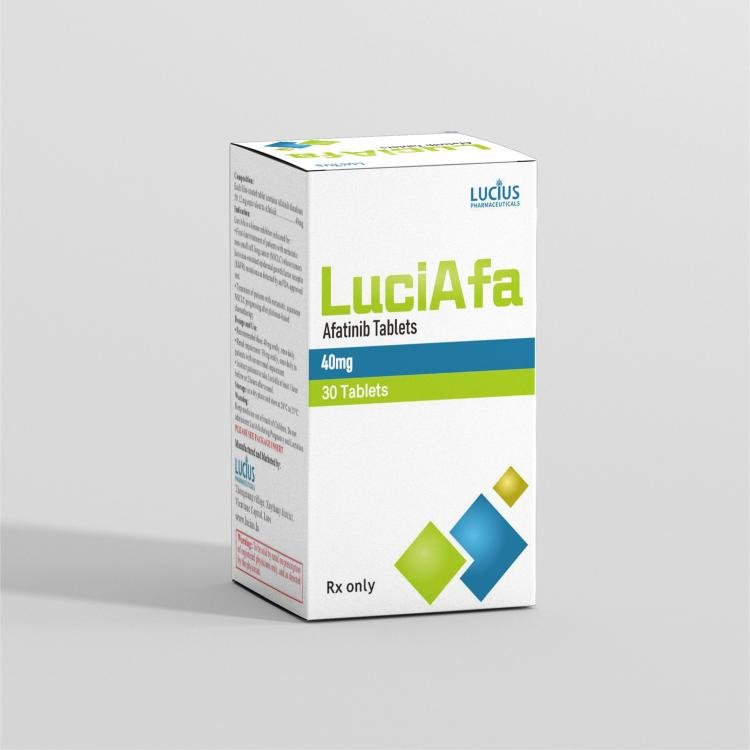
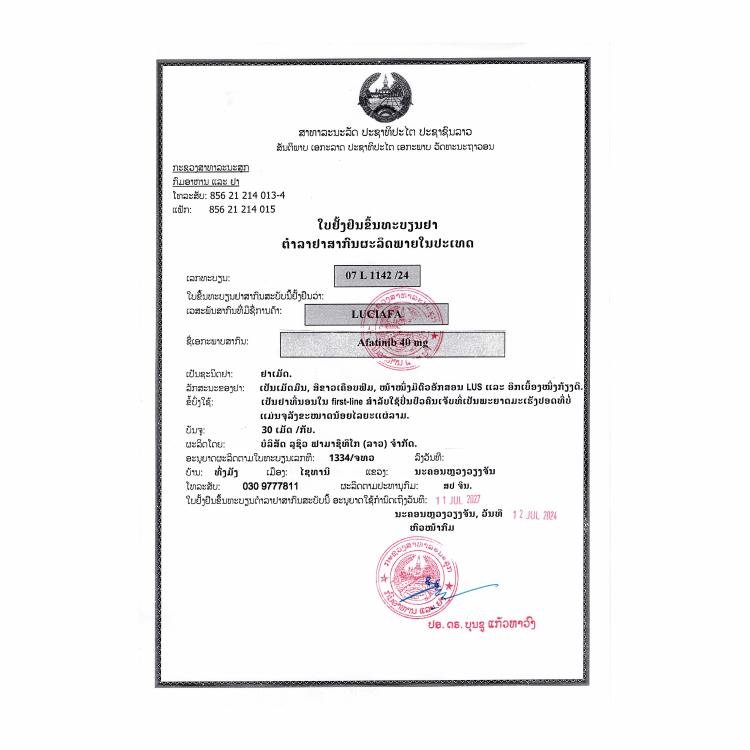
- Product name: LuciAfa Afatinib 40mg
- Manufacturer / brand: Laos Lucius Pharma
- Active ingredient: Afatinib
- Current strength: 40mg
- SKU: LU-ITEM-18
- Site category: second-generation EGFR-TKI, other cancer
Product Summary
LuciAfa Afatinib 40mg is an AISTIKA-listed product supplied by Laos Lucius Pharma. This page summarizes the product identity, strength, SKU, site category, and public medical reference information. Product name, manufacturer, packaging, and strength follow this AISTIKA product page.
Active Ingredient and Reference Data
Afatinib is the active ingredient used for this product page. Public prescribing information for Afatinib was used for the medical reference sections. Medical details are provided for reference and must be interpreted by a qualified healthcare professional.
Mechanism of Action
Afatinib covalently binds to the kinase domains of EGFR (ErbB1), HER2 (ErbB2), and HER4 (ErbB4) and irreversibly inhibits tyrosine kinase autophosphorylation, resulting in downregulation of ErbB signaling. Certain mutations in EGFR, including non-resistant mutations in its kinase domain, can result in increased autophosphorylation of the receptor, leading to receptor activation, sometimes in the absence of ligand binding, and can support cell proliferation in NSCLC.
Reference Indications
Afatinib is a kinase inhibitor indicated for: First-line treatment of patients with metastatic non-small cell lung cancer (NSCLC) whose tumors have non-resistant epidermal growth factor receptor (EGFR) mutations as detected by an FDA-approved test Limitations of Use : Safety and efficacy of Afatinib were not established in patients whose tumors have resistant EGFR mutations Treatment of patients with metastatic, squamous NSCLC progressing after platinum-based chemotherapy 1.1 EGFR Mutation-Positive, Metastatic Non-Small Cell Lung Cancer Afatinib is indicated for the first-line treatment of patients with metastatic non-small cell lung cancer (NSCLC) whose tumors have non-resistant epidermal growth factor receptor (EGFR) mutations as detected by an FDA-approved test .
Reference Dosage and Administration
Recommended dosage : 40 mg orally once daily Renal impairment : 30 mg orally once daily in patients with severe renal impairment ( 2. take Afatinib at least 1 hour before or 2 hours after a meal for Non-Resistant EGFR Mutation-Positive Metastatic NSCLC Select patients for first-line treatment of metastatic NSCLC with Afatinib based on the presence of non-resistant EGFR mutations in tumor specimens .
With this 40mg product, that corresponds to 1 x 40mg tablet when that reference dose is clinically appropriate.
This reference dosage is not an individualized prescription. Dose changes, treatment interruptions, or discontinuation must be directed by a physician.
Important Safety Information
Diarrhea : Diarrhea may result in dehydration and renal failure. Withhold Afatinib for severe and prolonged diarrhea not responsive to anti-diarrheal agents. ( 2.3 , 5.1 ) Bullous and exfoliative skin disorders : Severe bullous, blistering, and exfoliating lesions occurred in 0.2% of patients. Discontinue for life-threatening cutaneous reactions. Withhold Afatinib for severe and prolonged cutaneous reactions. ( 2.3 , 5.2 ) Interstitial lung disease (ILD) : Occurs in 1.6% of patients. Withhold Afatinib for acute onset or worsening of pulmonary symptoms. Discontinue Afatinib if ILD is diagnosed. ( 2.3 , 5.3 ) Hepatic toxicity : Fatal hepatic impairment occurs in 0.2% of patients. Monitor with periodic liver testing. Withhold or discontinue Afatinib for severe or worsening liver tests.
Common Adverse Reactions and Monitoring
The mean exposure was 5.5 months. The population included patients with various cancers, the most common of which were NSCLC, breast, colorectal, brain, and head and neck. The data described below reflect exposure to Afatinib as a single agent in LUX-Lung 3, a randomized, active-controlled trial conducted in patients with EGFR mutation-positive, metastatic NSCLC, and in LUX-Lung 8, a randomized, active-controlled trial in patients with metastatic squamous NSCLC progressing after platinum-based chemotherapy.
Drug Interactions and Special Populations
P-glycoprotein (P-gp) Inhibitors : Co-administration of P-gp inhibitors can increase afatinib exposure. Reduce Afatinib by 10 mg per day if not tolerated. ( 2.5 , 7 ) P-gp Inducers : Co-administration of chronic P-gp inducers orally can decrease afatinib exposure. Increase Afatinib by 10 mg per day as tolerated. ( 2.5 , 7 ) Effect of P-glycoprotein (P-gp) Inhibitors and Inducers Concomitant taking of P-gp inhibitors (including but not limited to ritonavir, cyclosporine A, ketoconazole, itraconazole, erythromycin, verapamil, quinidine, tacrolimus, nelfinavir, saquinavir, and amiodarone) with Afatinib can increase exposure to afatinib . Reduce Afatinib daily dose as recommended . Concomitant taking of P-gp inducers (including but not limited to rifampicin, carbamazepine, phenytoin, phenobarbital, and St.
Storage and Purchase Notes
Store according to the package or pharmacist instructions and keep out of reach of children. Before ordering, confirm product name, strength, quantity, price, shipping details, and payment method. After receipt, check packaging, batch number, expiration date, and storage conditions.
Sources
Sources: Gilotrif public prescribing information; openFDA/DailyMed public label data. These sources are used for public medical reference. Product information follows this AISTIKA product page.
DisclaimerProduct details, availability, pricing, and checkout information can change. Please review this product page carefully and consult a qualified healthcare professional before using any medicine.
Reviews
There are no reviews yet.