Product Details
Product Information
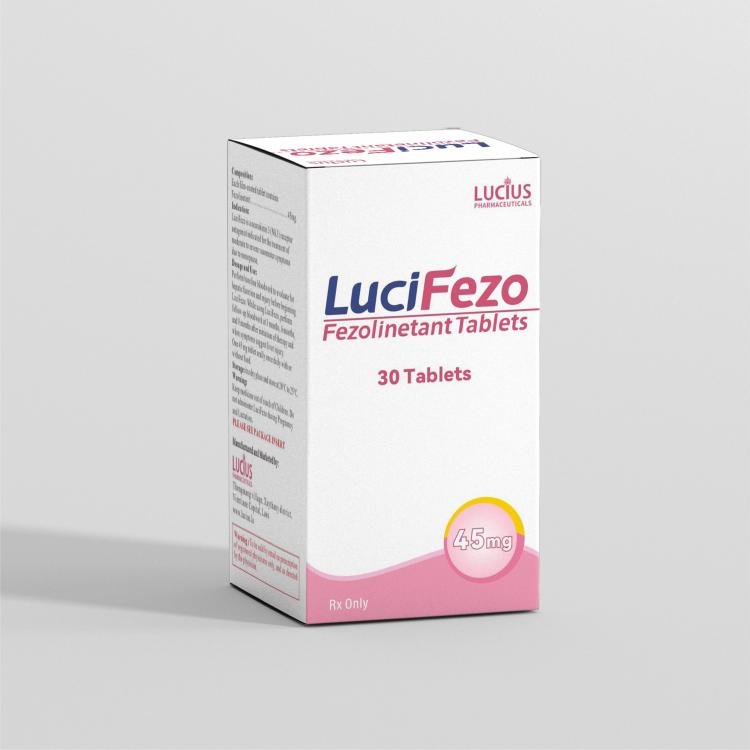
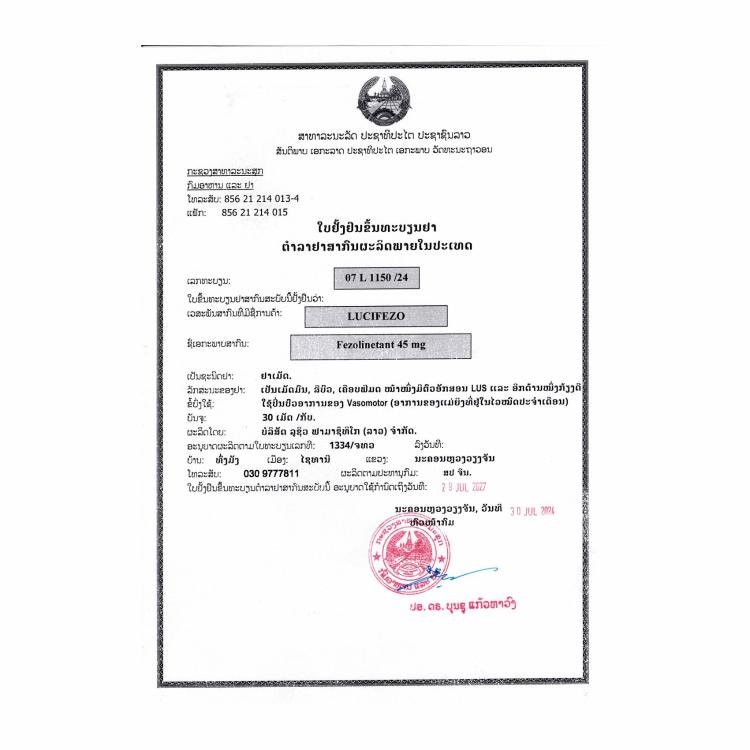
- Product name: LuciFezo Fezolinetant 45mg
- Manufacturer / brand: Laos Lucius Pharma
- Active ingredient: Fezolinetant
- Current strength: 45mg
- SKU: LU-ITEM-59
- Site category: other cancer
Product Summary
LuciFezo Fezolinetant 45mg is an AISTIKA-listed product supplied by Laos Lucius Pharma. This page summarizes the product identity, strength, SKU, site category, and public medical reference information. Product name, manufacturer, packaging, and strength follow this AISTIKA product page.
Active Ingredient and Reference Data
Fezolinetant is the active ingredient used for this product page. Public prescribing information for Fezolinetant was used for the medical reference sections. Medical details are provided for reference and must be interpreted by a qualified healthcare professional.
Mechanism of Action
Fezolinetant is a neurokinin 3 (NK3) receptor antagonist that blocks neurokinin B (NKB) binding on the kisspeptin/neurokinin B/dynorphin (KNDy) neuron to modulate neuronal activity in the thermoregulatory center. Fezolinetant has high affinity for the NK3 receptor (Ki value of 19.9 to 22.1 nmol/L), which is more than 450-fold higher than binding affinity to NK1 or NK2 receptors.
Reference Indications
Fezolinetant ® is indicated for the treatment of moderate to severe vasomotor symptoms due to menopause. Fezolinetant is a neurokinin 3 (NK3) receptor antagonist indicated for the treatment of moderate to severe vasomotor symptoms due to menopause.
Reference Dosage and Administration
The public label should be checked for the indication-specific recommended dosage. Available administration instructions note that the medicine may be taken with or without food.
Dose conversion must be confirmed by a physician because the reference dose may vary by indication, organ function, toxicity, or interacting medicines.
This reference dosage is not an individualized prescription. Dose changes, treatment interruptions, or discontinuation must be directed by a physician.
Important Safety Information
WARNING: RISKS OF HEPATOTOXICITY Hepatotoxicity has occurred with the use of Fezolinetant in the postmarketing setting . Perform hepatic laboratory tests prior to initiation of treatment to evaluate for hepatic function and injury. Do not start Fezolinetant if either aminotransferase is ≥ 2 x the upper limit of normal (ULN) or if the total bilirubin is ≥ 2 x ULN for the evaluating laboratory. Perform follow-up hepatic laboratory testing monthly for the first 3 months, at 6 months, and 9 months of treatment ( 2.1 , 5.1 ). Advise patients to discontinue Fezolinetant immediately and seek medical attention including hepatic laboratory tests if they experience signs or symptoms that may suggest liver injury (new onset fatigue, decreased appetite, nausea, vomiting, pruritus, jaundice, pale feces, dark urine, or abdominal pain) ( 2.1 , 5.1 ).
Common Adverse Reactions and Monitoring
The safety of Fezolinetant was evaluated in three 52-week clinical trials . Across the three clinical trials, a total of 1100 women received Fezolinetant. Trials 1 and 2 were placebo-controlled for the first 12 weeks, followed by re-randomization of women previously receiving placebo to Fezolinetant (women on Fezolinetant remained on Fezolinetant) for an additional 40 weeks of uncontrolled treatment. Trial 3 was a randomized, placebo-controlled, double-blind safety study evaluating the safety of Fezolinetant for 52 weeks. ) Placebo (n=610) Total Person-Years=475.0 n (%, EAIR ) Abdominal pain Abdominal pain (including Abdominal pain, Abdominal pain lower, Abdominal pain upper).
Drug Interactions and Special Populations
Concomitant use of Fezolinetant with drugs that are weak, moderate, or strong CYP1A2 inhibitors, increase the plasma C max and AUC of Fezolinetant . Fezolinetant is contraindicated in individuals using CYP1A2 inhibitors. Additionally, in the male offspring delayed male reproductive maturation was observed, characterized by incomplete preputial separation, which affected male fertility at doses above the human therapeutic dose in rats . general population, the estimated background risk of major birth defects or miscarriage in clinically recognized pregnancies are 2-4% and 15-20%, respectively. Data Animal Data In embryo-fetal development toxicity studies in rats and rabbits, embryo-lethality was noted at the highest doses (128- and 174-fold the human AUC 24 at the human therapeutic dose for rats and rabbits, respectively).
Storage and Purchase Notes
Store according to the package or pharmacist instructions and keep out of reach of children. Before ordering, confirm product name, strength, quantity, price, shipping details, and payment method. After receipt, check packaging, batch number, expiration date, and storage conditions.
Sources
Sources: VEOZAH public prescribing information; openFDA/DailyMed public label data. These sources are used for public medical reference. Product information follows this AISTIKA product page.
DisclaimerProduct details, availability, pricing, and checkout information can change. Please review this product page carefully and consult a qualified healthcare professional before using any medicine.
Reviews
There are no reviews yet.