Product Details
Product Information
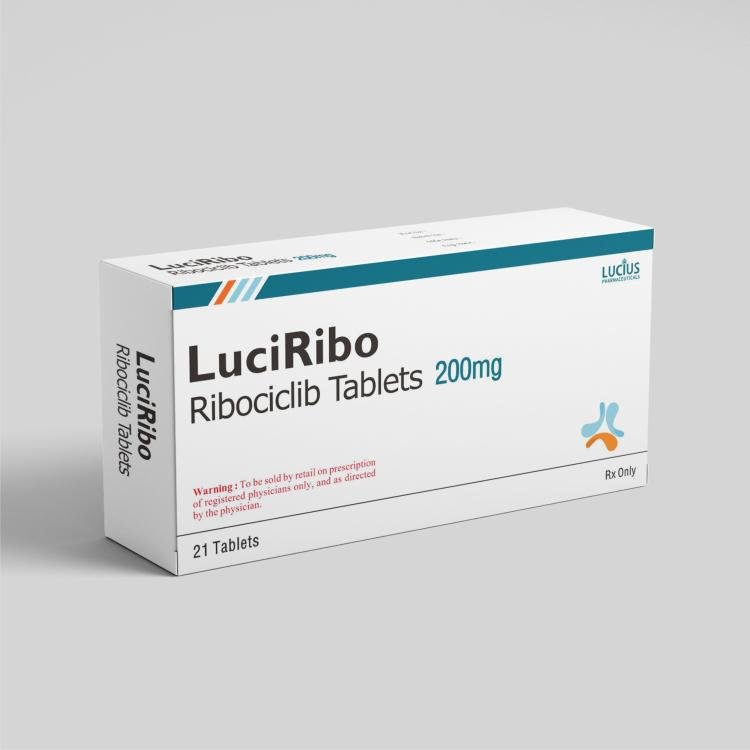
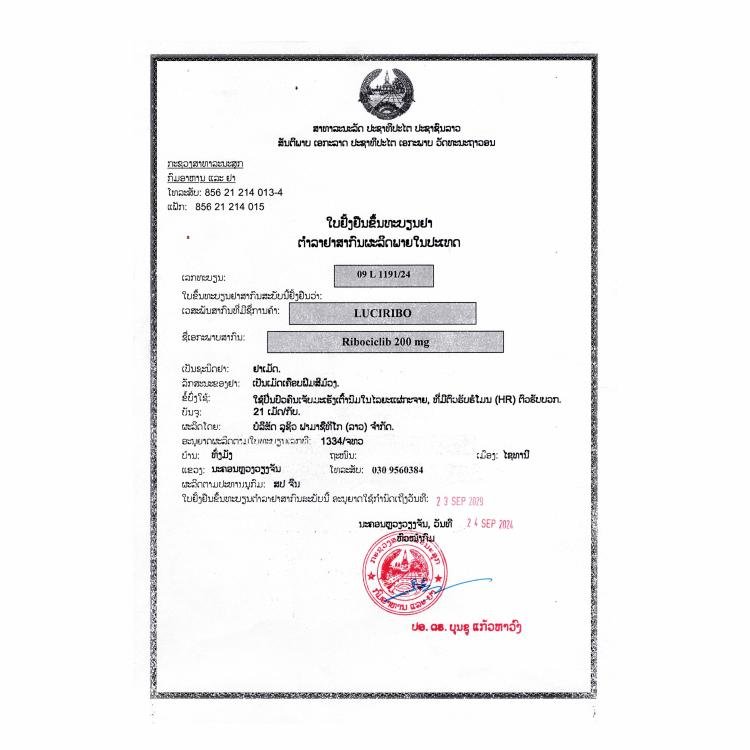
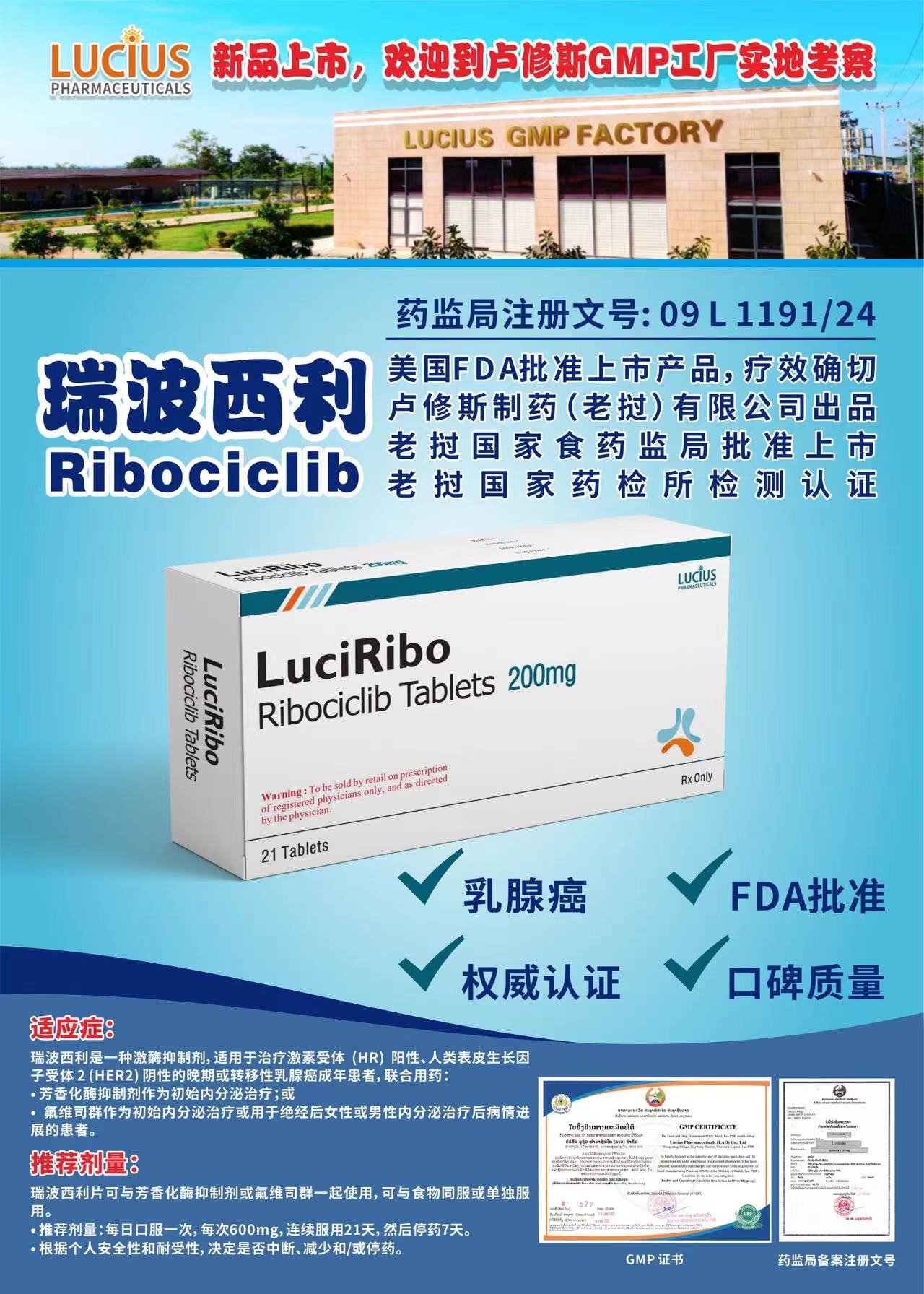
- Product name: LuciRibo Ribociclib 200mg
- Manufacturer / brand: Laos Lucius Pharma
- Active ingredient: Ribociclib
- Current strength: 200mg
- SKU: LU-ITEM-97
- Site category: CDK4/6 target, breast cancer, other cancer
Product Summary
LuciRibo Ribociclib 200mg is an AISTIKA-listed product supplied by Laos Lucius Pharma. This page summarizes the product identity, strength, SKU, site category, and public medical reference information. Product name, manufacturer, packaging, and strength follow this AISTIKA product page.
Active Ingredient and Reference Data
Ribociclib is the active ingredient used for this product page. Public prescribing information for Ribociclib was used for the medical reference sections. Medical details are provided for reference and must be interpreted by a qualified healthcare professional.
Mechanism of Action
Ribociclib is an inhibitor of cyclin-dependent kinase (CDK) 4 and 6. These kinases are activated upon binding to D-cyclins and are downstream of signaling pathways, which lead to cell cycle progression and cellular proliferation. The cyclin D-CDK4/6 complex regulates cell cycle progression through phosphorylation of the retinoblastoma protein (pRb). Letrozole is a nonsteroidal competitive inhibitor of the aromatase enzyme system by competitively binding to the heme of the cytochrome P450 subunit of the enzyme, resulting in a reduction of estrogen biosynthesis in all tissues.
Reference Indications
Ribociclib, a co-packaged product containing ribociclib, a kinase inhibitor, and letrozole, an aromatase inhibitor, is indicated: for the adjuvant treatment of adults with hormone receptor (HR)-positive, human epidermal growth factor receptor 2 (HER2)-negative stage II and III early breast cancer at high risk of recurrence. as initial endocrine-based therapy for the treatment of adults with HR-positive, HER2-negative advanced or metastatic breast cancer therapy.
Reference Dosage and Administration
Recommended dosage of KISQALI is 400 mg (two 200 mg film-coated tablets) taken orally, once daily for 21 consecutive days followed by 7 days off in 28-day treatment cycles. taken in combination orally with or without food.
With this 200mg product, that corresponds to 2 x 200mg tablets when that reference dose is clinically appropriate.
This reference dosage is not an individualized prescription. Dose changes, treatment interruptions, or discontinuation must be directed by a physician.
Important Safety Information
Interstitial Lung Disease (ILD)/Pneumonitis: Patients treated with CDK 4/6 inhibitors should be monitored for pulmonary symptoms indicative of ILD/pneumonitis. Interrupt and evaluate patients with new or worsening respiratory symptoms suspected to be due to ILD/pneumonitis. Permanently discontinue KISQALI in patients with recurrent symptomatic or severe ILD/pneumonitis. Permanently discontinue KISQALI in patients with SCARs or other life-threatening cutaneous reactions. ( 2.2 , 5.2 ) QT Interval Prolongation: Monitor electrocardiograms (ECGs) and electrolytes prior to initiation of treatment with KISQALI. Repeat ECGs at approximately Day 14 of the first cycle, and as clinically indicated. Monitor electrolytes at the beginning of each cycle for 6 cycles, and as clinically indicated.
Common Adverse Reactions and Monitoring
The data described in reflect exposure to KISQALI plus non-steroidal aromatase inhibitor (NSAI) in 2526 patients with early breast cancer (NATALEE), of whom 51% completed 36 months of KISQALI treatment. NATALEE: KISQALI in Combination with a Non-steroidal Aromatase Inhibitor as Adjuvant Treatment Adults with HR-positive, HER2-negative Stage II and III Early Breast Cancer at High Risk of Recurrence The safety of KISQALI was evaluated in NATALEE, a clinical trial of 5101 patients who received KISQALI plus NSAI or NSAI alone, with or without goserelin . The median duration of exposure to KISQALI was 33 months.
Drug Interactions and Special Populations
Ribociclib CYP3A4 Inhibitors: Avoid concomitant use of Ribociclib with strong CYP3A inhibitors. If strong inhibitors cannot be avoided, reduce KISQALI dose. ( 2.2, 7.1 ) CYP3A4 Inducers: Avoid concomitant use of Ribociclib with strong CYP3A inducers. CYP3A Substrates: The dose of CYP3A substrates with narrow therapeutic indices may need to be reduced when given concurrently with Ribociclib. Drugs Known to Prolong QT Interval: Avoid concomitant use of drugs known to prolong QT interval, such as anti-arrhythmic medicines. Avoid concomitant use of strong CYP3A inhibitors with KISQALI and consider alternative concomitant medications with less potential for CYP3A inhibition. Avoid concomitant use of strong CYP3A inducers and consider an alternate concomitant medication with no or minimal potential to induce CYP3A.
Storage and Purchase Notes
Store according to the package or pharmacist instructions and keep out of reach of children. Before ordering, confirm product name, strength, quantity, price, shipping details, and payment method. After receipt, check packaging, batch number, expiration date, and storage conditions.
Sources
Sources: KISQALI FEMARA CO-PACK public prescribing information; openFDA/DailyMed public label data. These sources are used for public medical reference. Product information follows this AISTIKA product page.
DisclaimerProduct details, availability, pricing, and checkout information can change. Please review this product page carefully and consult a qualified healthcare professional before using any medicine.
Reviews
There are no reviews yet.