
Product Details
Product Information
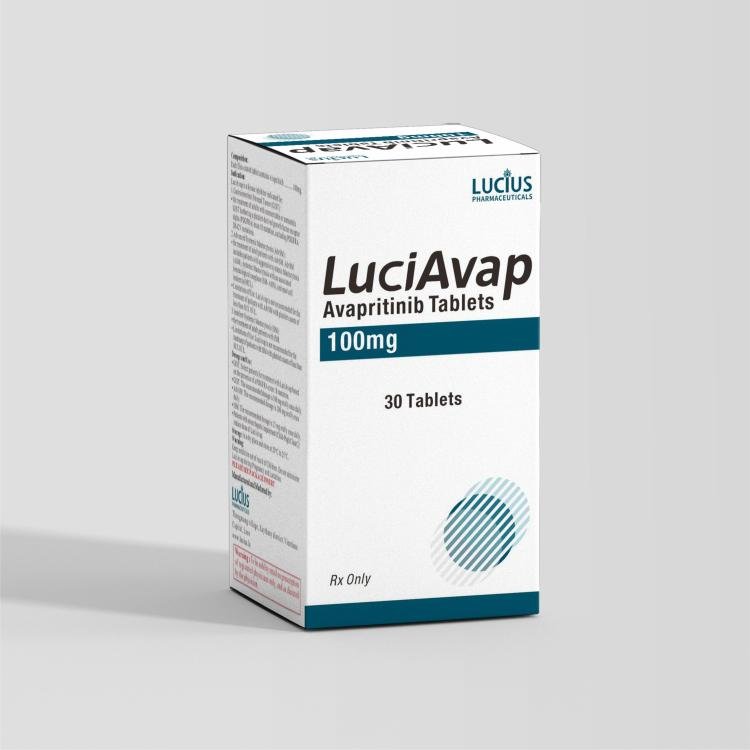
- Product name: LuciAvap Avapritinib 100mg
- Manufacturer / brand: Laos Lucius Pharma
- Active ingredient: Avapritinib
- Current strength: 100mg
- SKU: LU-ITEM-132
- Site category: PDGFRA target, other cancer
Product Summary
LuciAvap Avapritinib 100mg is an AISTIKA-listed product supplied by Laos Lucius Pharma. This page summarizes the product identity, strength, SKU, site category, and public medical reference information. Product name, manufacturer, packaging, and strength follow this AISTIKA product page.
Active Ingredient and Reference Data
Avapritinib is the active ingredient used for this product page. Public prescribing information for Avapritinib was used for the medical reference sections. Medical details are provided for reference and must be interpreted by a qualified healthcare professional.
Mechanism of Action
Avapritinib is a tyrosine kinase inhibitor that targets KIT D816V, PDGFRA and PDGFRA D842 mutants as well as multiple KIT exon 11, 11/17 and 17 mutants with half maximal inhibitory concentrations (IC 50s ) less than 25 nM in biochemical assays. Certain mutations in PDGFRA and KIT can result in the autophosphorylation and constitutive activation of these receptors which can contribute to tumor and mast cell proliferation. Other potential targets for avapritinib include wild type KIT, PDGFRB, and CSFR1.
Reference Indications
Avapritinib is a kinase inhibitor indicated for: Gastrointestinal Stromal Tumor (GIST) the treatment of adults with unresectable or metastatic GIST harboring a platelet-derived growth factor receptor alpha (PDGFRA) exon 18 mutation, including PDGFRA D842V mutations. ( 1.1 , 2.2 ) Advanced Systemic Mastocytosis (AdvSM) the treatment of adult patients with AdvSM. AdvSM includes patients with aggressive systemic mastocytosis (ASM), systemic mastocytosis with an associated hematological neoplasm (SM-AHN), and mast cell leukemia (MCL). Limitations of Use: Avapritinib is not recommended for the treatment of patients with AdvSM with platelet counts of less than 50 × 10 9 /L Indolent Systemic Mastocytosis (ISM) the treatment of adult patients with ISM.
Reference Dosage and Administration
Recommended dosage is 300 mg orally once daily. Administer Avapritinib orally on an empty stomach, at least 1 hour before or 2 hours after a meal .
With this 100mg product, that corresponds to 3 x 100mg tablets when that reference dose is clinically appropriate.
This reference dosage is not an individualized prescription. Dose changes, treatment interruptions, or discontinuation must be directed by a physician.
Important Safety Information
Intracranial Hemorrhage : Permanently discontinue for any occurrence of any grade. ( 2.5 , 5.2 ) Photosensitivity: May cause photosensitivity reactions. Advise patients to limit direct ultraviolet exposure. Embryo-Fetal Toxicity : Can cause fetal harm. Advise females and males of reproductive potential of the potential risk to a fetus and to use effective contraception. ( 5.4 , 8.1 , 8.3 ) 5.1 Intracranial Hemorrhage Serious intracranial hemorrhage may occur with Avapritinib treatment; fatal events occurred in less than 1% of patients. Overall, intracranial hemorrhage (e.g., subdural hematoma, intracranial hemorrhage, and cerebral hemorrhage) occurred in 2.9% of the 749 patients with GIST or AdvSM who received Avapritinib in clinical trials.
Common Adverse Reactions and Monitoring
AdvSM (≥20% incidence): edema, diarrhea, nausea, and fatigue/asthenia. ISM (≥10% incidence): eye edema, dizziness, peripheral edema and flushing. The data in the reflect exposure to Avapritinib at 25 mg to 600 mg orally once daily in 995 patients enrolled in one of five clinicals trials conducted in patients with advanced malignancies and systemic mastocytosis, including NAVIGATOR, EXPLORER, PATHFINDER and PIONEER . These patients included 601 patients with GIST, 148 patients with AdvSM and 246 patients with ISM. Among the 995 patients receiving Avapritinib, 54% were exposed for 6 months or longer and 26% were exposed for greater than 1 year.
Drug Interactions and Special Populations
Strong and Moderate CYP3A Inhibitors : Avoid coadministration of Avapritinib with strong and moderate CYP3A inhibitors. If coadministration of Avapritinib with a moderate inhibitor cannot be avoided, reduce dose of Avapritinib in patients with GIST or AdvSM. ( 2.6 , 7.1 ) Strong and Moderate CYP3A Inducers : Avoid coadministration of Avapritinib with strong and moderate CYP3A inducers. Avoid coadministration of Avapritinib with strong or moderate CYP3A inhibitors. If coadministration of Avapritinib with a moderate CYP3A inhibitor cannot be avoided, reduce the dose of Avapritinib . Strong and Moderate CYP3A Inducers Coadministration of Avapritinib with a strong or moderate CYP3A inducer decreases avapritinib plasma concentrations , which may decrease efficacy of Avapritinib.
Storage and Purchase Notes
Store according to the package or pharmacist instructions and keep out of reach of children. Before ordering, confirm product name, strength, quantity, price, shipping details, and payment method. After receipt, check packaging, batch number, expiration date, and storage conditions.
Sources
Sources: Ayvakit public prescribing information; openFDA/DailyMed public label data. These sources are used for public medical reference. Product information follows this AISTIKA product page.
DisclaimerProduct details, availability, pricing, and checkout information can change. Please review this product page carefully and consult a qualified healthcare professional before using any medicine.
Reviews
There are no reviews yet.