
Product Details
Product Information
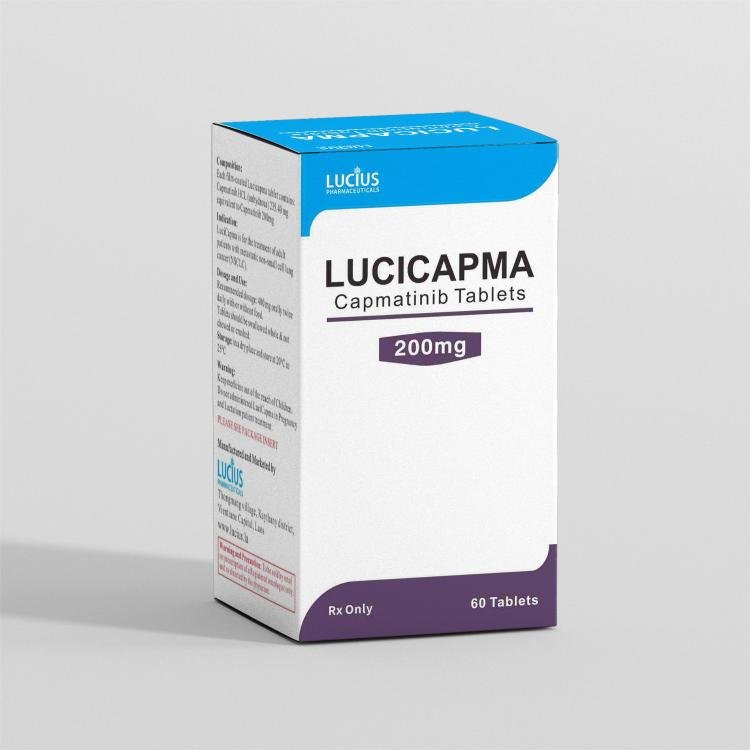
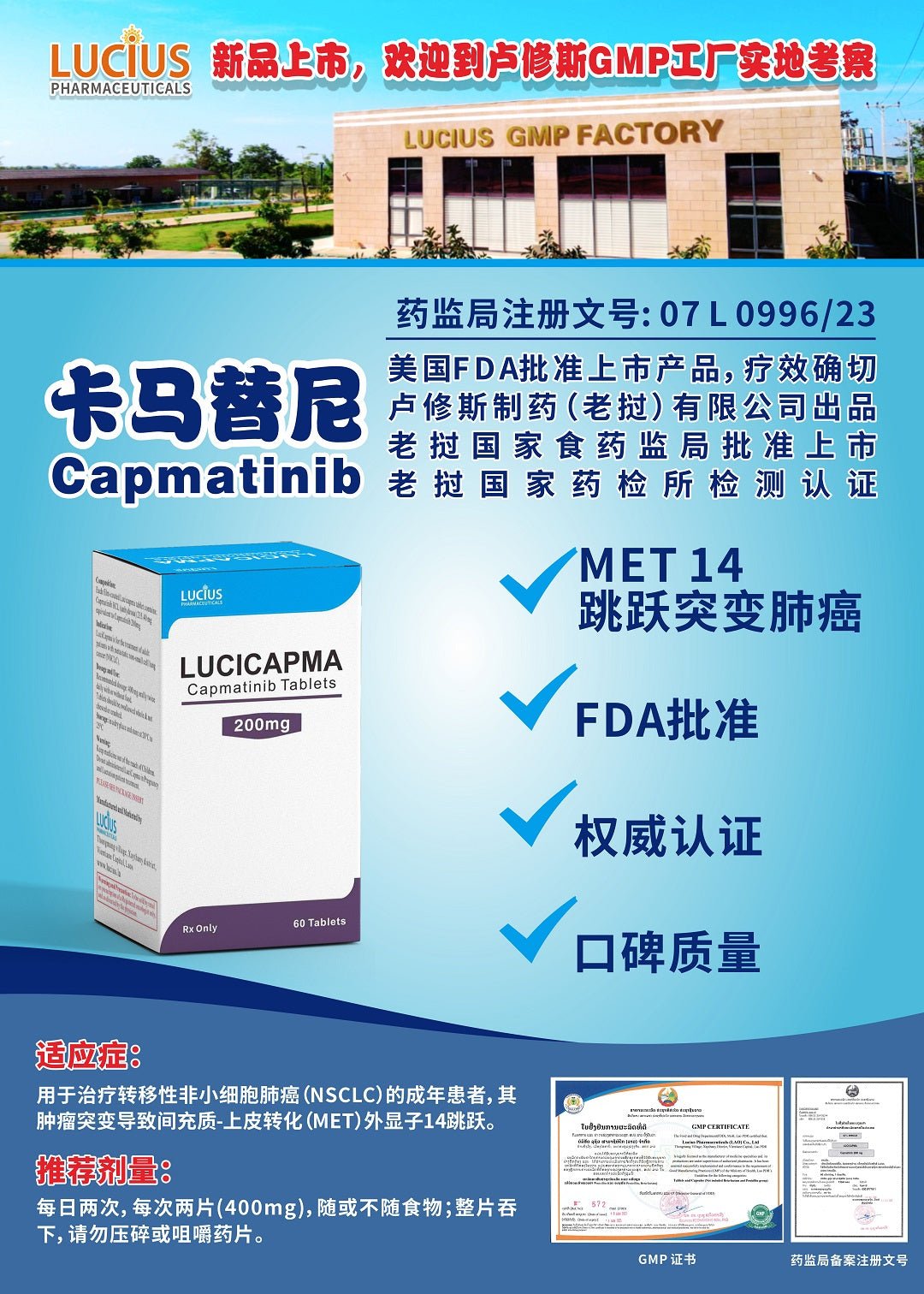
- Product name: LuciCapma Capmatinib 200mg
- Manufacturer / brand: Laos Lucius Pharma
- Active ingredient: Capmatinib
- Current strength: 200mg
- SKU: LU-ITEM-133
- Site category: MET target, other cancer
Product Summary
LuciCapma Capmatinib 200mg is an AISTIKA-listed product supplied by Laos Lucius Pharma. This page summarizes the product identity, strength, SKU, site category, and public medical reference information. Product name, manufacturer, packaging, and strength follow this AISTIKA product page.
Active Ingredient and Reference Data
Capmatinib is the active ingredient used for this product page. Public prescribing information for Capmatinib was used for the medical reference sections. Medical details are provided for reference and must be interpreted by a qualified healthcare professional.
Mechanism of Action
Capmatinib is a kinase inhibitor that targets MET, including the mutant variant produced by exon 14 skipping. MET exon 14 skipping results in a protein with a missing regulatory domain that reduces its negative regulation leading to increased downstream MET signaling. Capmatinib inhibited cancer cell growth driven by a mutant MET variant lacking exon 14 at clinically achievable concentrations and demonstrated anti-tumor activity in murine tumor xenograft models derived from human lung tumors with either a mutation leading to MET exon 14 skipping or MET amplification.
Reference Indications
Capmatinib is indicated for the treatment of adult patients with metastatic non-small cell lung cancer (NSCLC) whose tumors have a mutation that leads to mesenchymal-epithelial transition (MET) exon 14 skipping as detected by an FDA-approved test. Capmatinib is a kinase inhibitor indicated for the treatment of adult patients with metastatic non-small cell lung cancer (NSCLC) whose tumors have a mutation that leads to mesenchymal-epithelial transition (MET) exon 14 skipping as detected by an FDA-approved test.
Reference Dosage and Administration
Recommended Dosage : 400 mg orally twice daily with or without food.
With this 200mg product, that corresponds to 2 x 200mg tablets when that reference dose is clinically appropriate.
This reference dosage is not an individualized prescription. Dose changes, treatment interruptions, or discontinuation must be directed by a physician.
Important Safety Information
Interstitial Lung Disease (ILD)/Pneumonitis : Monitor for new or worsening pulmonary symptoms indicative of ILD/pneumonitis. Permanently discontinue Capmatinib in patients with ILD/pneumonitis. ( 2.3 , 5.1 ) Hepatotoxicity : Monitor liver function tests. Withhold, dose reduce, or permanently discontinue Capmatinib based on severity. ( 2.3 , 5.2 ) Pancreatic Toxicity : Monitor amylase and lipase levels. Withhold, dose reduce, or permanently discontinue Capmatinib based on severity. ( 2.3 , 5.3 ) Hypersensitivity Reactions : Withhold or permanently discontinue Capmatinib based on severity. ( 2.3 , 5.4 ) Risk of Photosensitivity : May cause photosensitivity reactions. Advise patients to limit direct ultraviolet exposure. Embryo-Fetal Toxicity : Can cause fetal harm.
Common Adverse Reactions and Monitoring
Metastatic Non-Small Cell Lung Cancer The safety of Capmatinib was evaluated in GEOMETRY mono-1 . Patients received Capmatinib 400 mg orally twice daily until disease progression or unacceptable toxicity (N = 373). Among patients who received Capmatinib, 37% were exposed for at least 6 months and 22% were exposed for at least one year. Permanent discontinuation of Capmatinib due to an adverse reaction occurred in 17% of patients. Dose interruptions due to an adverse reaction occurred in 57% of patients who received Capmatinib. Dose reductions due to an adverse reaction occurred in 26% of patients who received Capmatinib.
Drug Interactions and Special Populations
Strong and Moderate CYP3A Inducers : Avoid concomitant use. Strong and Moderate CYP3A Inducers Coadministration of Capmatinib with a strong CYP3A inducer decreased capmatinib exposure. Coadministration of Capmatinib with a moderate CYP3A inducer may also decrease capmatinib exposure. Decreases in capmatinib exposure may decrease Capmatinib anti-tumor activity . Avoid coadministration of Capmatinib with strong and moderate CYP3A inducers. Lactation : Advise not to breastfeed. There are no available data on Capmatinib use in pregnant women. Oral administration of capmatinib to pregnant rats and rabbits during the period of organogenesis resulted in malformations at maternal exposures less than the human exposure based on AUC at the 400 mg twice daily clinical dose ( see Data ). Advise pregnant women of the potential risk to a fetus.
Storage and Purchase Notes
Store according to the package or pharmacist instructions and keep out of reach of children. Before ordering, confirm product name, strength, quantity, price, shipping details, and payment method. After receipt, check packaging, batch number, expiration date, and storage conditions.
Sources
Sources: TABRECTA public prescribing information; openFDA/DailyMed public label data. These sources are used for public medical reference. Product information follows this AISTIKA product page.
DisclaimerProduct details, availability, pricing, and checkout information can change. Please review this product page carefully and consult a qualified healthcare professional before using any medicine.

Reviews
There are no reviews yet.