
Product Details
Product Information
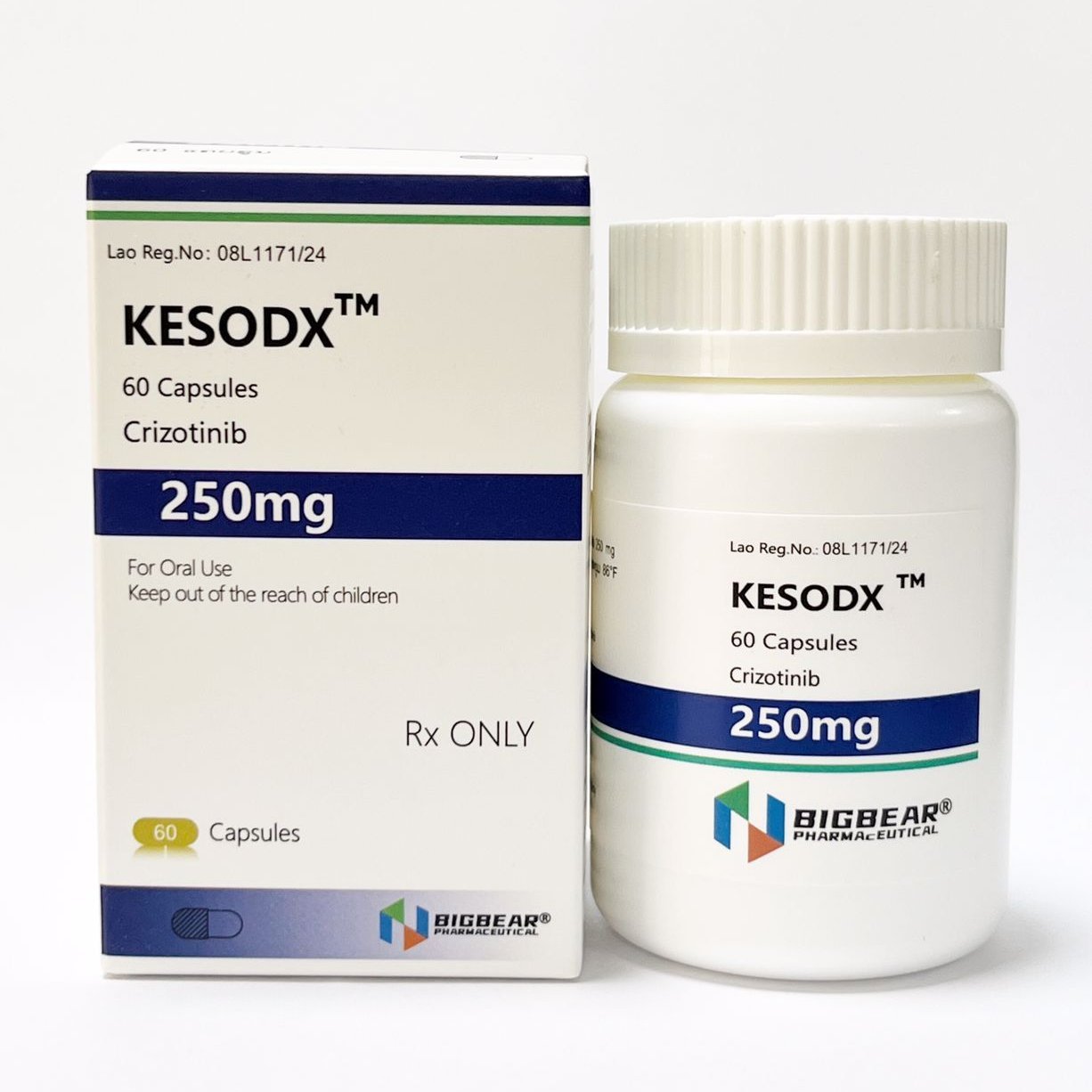
- Product name: KESODX Crizotinib as shown on package
- Manufacturer / brand: Laos BigBear Pharma
- Active ingredient: Crizotinib
- Current strength: as shown on package
- SKU: BB-ITEM-45
- Site category: first generation, ROS1 target, other cancer
Product Summary
KESODX Crizotinib as shown on package is an AISTIKA-listed product supplied by Laos BigBear Pharma. This page summarizes the product identity, strength, SKU, site category, and public medical reference information. Product name, manufacturer, packaging, and strength follow this AISTIKA product page.
Active Ingredient and Reference Data
Crizotinib is the active ingredient used for this product page. Public prescribing information for Crizotinib was used for the medical reference sections. Medical details are provided for reference and must be interpreted by a qualified healthcare professional.
Mechanism of Action
Crizotinib is an inhibitor of receptor tyrosine kinases including ALK, Hepatocyte Growth Factor Receptor (HGFR, c-Met), ROS1 (c-ros), and Recepteur d’Origine Nantais (RON). Translocations can affect the ALK gene resulting in the expression of oncogenic fusion proteins. The formation of ALK fusion proteins results in activation and dysregulation of the gene’s expression and signaling which can contribute to increased cell proliferation and survival in tumors expressing these proteins.
Reference Indications
Crizotinib is a kinase inhibitor indicated for the treatment of adult patients with metastatic non-small cell lung cancer (NSCLC) whose tumors are anaplastic lymphoma kinase (ALK) or ROS1-positive as detected by an FDA-approved test. ( 1.1 , 2.1 ) pediatric patients 1 year of age and older and young adults with relapsed or refractory, systemic anaplastic large cell lymphoma (ALCL) that is ALK-positive. ( 1.2 , 2.3 ) o Limitations of Use: The safety and efficacy of Crizotinib have not been established in older adults with relapsed or refractory, systemic ALK-positive ALCL. adult and pediatric patients 1 year of age and older with unresectable, recurrent, or refractory inflammatory myofibroblastic tumor (IMT) that is ALK-positive.
Reference Dosage and Administration
Recommended dosage is 250 mg orally twice daily. with or without food until disease progression or unacceptable toxicity occurs.
Dose conversion must be confirmed by a physician because the reference dose may vary by indication, organ function, toxicity, or interacting medicines.
This reference dosage is not an individualized prescription. Dose changes, treatment interruptions, or discontinuation must be directed by a physician.
Important Safety Information
Hepatotoxicity: Fatal hepatotoxicity has occurred. Monitor with periodic liver testing. Temporarily suspend, dose reduce, or permanently discontinue Crizotinib. ( 2.2 , 2.6 , 5.1 ) Interstitial Lung Disease (ILD)/Pneumonitis: Permanently discontinue in patients with ILD/pneumonitis. ( 2.6 , 5.2 ) QT Interval Prolongation: Monitor electrocardiograms and electrolytes in patients who have a history of or predisposition for QTc prolongation, or who are taking medications that prolong QT. Temporarily suspend, dose reduce, or permanently discontinue Crizotinib. ( 2.6 , 5.3 ) Bradycardia: Crizotinib can cause bradycardia. Monitor heart rate and blood pressure regularly. Temporarily suspend, dose reduce, or permanently discontinue Crizotinib. ( 2.6 , 5.4 ) Severe Visual Loss: Crizotinib can cause visual changes including severe visual loss.
Common Adverse Reactions and Monitoring
Grade 3–4 laboratory abnormalities (≥15%) are neutropenia, lymphopenia, and thrombocytopenia. The data also reflect exposure to Crizotinib in 121 patients ages 1 to ≤21 years with relapsed or refractory tumors, including 26 patients with systemic ALCL and 14 pediatric patients with IMT, in a single-arm trial (Study ADVL0912). The data are also described for 7 adult patients with IMT treated with Crizotinib in a single-arm trial (Study A8081013).
Drug Interactions and Special Populations
Strong CYP3A Inhibitors: Avoid concomitant use. ( 2.9 , 7.1 ) Strong CYP3A Inducers: Avoid concomitant use. Avoid concomitant use of strong CYP3A inhibitors. If concomitant use of strong CYP3A inhibitors is unavoidable, reduce the Crizotinib dosage . Avoid grapefruit or grapefruit juice which may also increase plasma concentrations of crizotinib. Use caution with concomitant use of moderate CYP3A inhibitors. Strong CYP3A Inducers Concomitant use of crizotinib with strong CYP3A inducers decreases crizotinib plasma concentrations , which may decrease the efficacy of Crizotinib. Avoid concomitant use of strong CYP3A inducers. If concomitant use of Crizotinib is unavoidable, decrease the CYP3A substrate dosage in accordance with approved product labeling. Avoid concomitant use of Crizotinib with drugs that prolong the QT interval .
Storage and Purchase Notes
Store according to the package or pharmacist instructions and keep out of reach of children. Before ordering, confirm product name, strength, quantity, price, shipping details, and payment method. After receipt, check packaging, batch number, expiration date, and storage conditions.
Sources
Sources: Xalkori public prescribing information; openFDA/DailyMed public label data. These sources are used for public medical reference. Product information follows this AISTIKA product page.
DisclaimerProduct details, availability, pricing, and checkout information can change. Please review this product page carefully and consult a qualified healthcare professional before using any medicine.
Reviews
There are no reviews yet.