

Product Details
Product Information
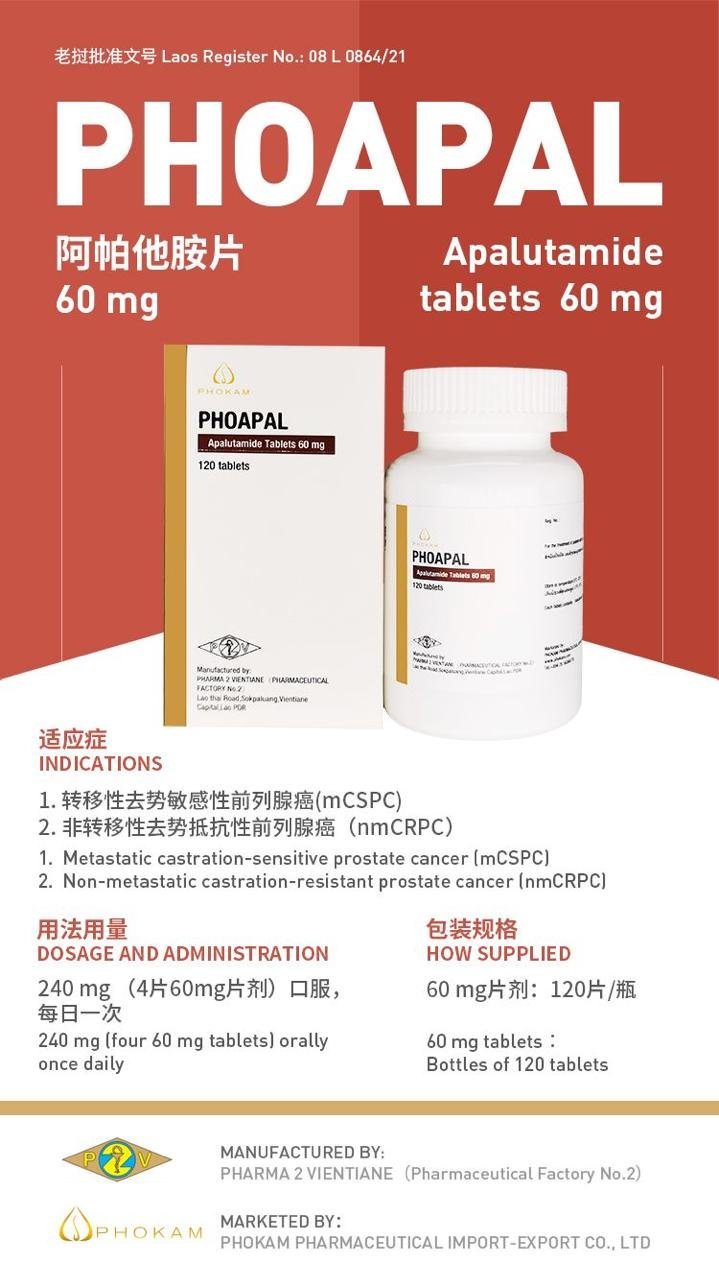
- Product name: PHOAPAL Apalutamide as shown on package
- Manufacturer / brand: Laos State Pharmaceutical No.2
- Active ingredient: Apalutamide
- Current strength: as shown on package
- SKU: L2-ITEM-10
- Site category: general medicines
Product Summary
PHOAPAL Apalutamide as shown on package is an AISTIKA-listed product supplied by Laos State Pharmaceutical No.2. This page summarizes the product identity, strength, SKU, site category, and public medical reference information. Product name, manufacturer, packaging, and strength follow this AISTIKA product page.
Active Ingredient and Reference Data
Apalutamide is the active ingredient used for this product page. Public prescribing information for Apalutamide was used for the medical reference sections. Medical details are provided for reference and must be interpreted by a qualified healthcare professional.
Mechanism of Action
Apalutamide is an Androgen Receptor (AR) inhibitor that binds directly to the ligand-binding domain of the AR. Apalutamide inhibits AR nuclear translocation, inhibits DNA binding, and impedes AR-mediated transcription. A major metabolite, N-desmethyl apalutamide, is a less potent inhibitor of AR, and exhibited one-third the activity of apalutamide in an in vitro transcriptional reporter assay. Apalutamide administration caused decreased tumor cell proliferation and increased apoptosis leading to decreased tumor volume in mouse xenograft models of prostate cancer.
Reference Indications
Apalutamide is indicated for the treatment of patients with Metastatic castration-sensitive prostate cancer (mCSPC) Non-metastatic castration-resistant prostate cancer (nmCRPC) Apalutamide is an androgen receptor inhibitor indicated for the treatment of patients with metastatic castration-sensitive prostate cancer. non-metastatic castration-resistant prostate cancer.
Reference Dosage and Administration
Recommended dosage of Apalutamide is 240 mg orally once daily. Swallow tablets whole.
Dose conversion must be confirmed by a physician because the reference dose may vary by indication, organ function, toxicity, or interacting medicines.
This reference dosage is not an individualized prescription. Dose changes, treatment interruptions, or discontinuation must be directed by a physician.
Important Safety Information
Cerebrovascular and ischemic cardiovascular events occurred in patients receiving Apalutamide. Monitor for signs and symptoms of cerebrovascular disorders and ischemic heart disease. Optimize management of cardiovascular risk factors. Fractures occurred in patients receiving Apalutamide. Evaluate patients for fracture risk and treat patients with bone-targeted agents according to established guidelines. Falls occurred in patients receiving Apalutamide with increased incidence in the elderly. Evaluate patients for fall risk. Seizure occurred in 0.4% of patients receiving Apalutamide. Permanently discontinue Apalutamide in patients who develop a seizure during treatment. Interrupt Apalutamide if signs or symptoms of SCARs develop. Permanently discontinue if SCARs are confirmed.
Common Adverse Reactions and Monitoring
The following are discussed in more detail in other sections of the labeling: Cerebrovascular and Ischemic Cardiovascular Events . Interstitial Lung Disease (ILD) . Metastatic Castration-sensitive Prostate Cancer (mCSPC) TITAN, a randomized (1:1), double-blind, placebo-controlled, multi-center clinical study, enrolled patients who had mCSPC. All patients in the TITAN study received a concomitant gonadotropin-releasing hormone (GnRH) analog or had prior bilateral orchiectomy. The median duration of exposure was 20 months (range: 0 to 34 months) in patients who received Apalutamide and 18 months (range: 0.1 to 34 months) in patients who received placebo.
Drug Interactions and Special Populations
Concomitant use with medications that are sensitive substrates of CYP3A4, CYP2C19, CYP2C9, UGT, P-gp, BCRP, or OATP1B1 may result in loss of activity of these medications. Co-administration of a strong CYP2C8 or CYP3A4 inhibitor is predicted to increase the steady-state exposure of the active moieties (sum of unbound apalutamide plus the potency-adjusted unbound N-desmethyl-apalutamide). Consider alternative agents when possible or evaluate for loss of activity of the substrate if concomitant use cannot be avoided. Apalutamide is a strong inducer of CYP3A4 and CYP2C19, a weak inducer of CYP2C9, and an inducer of P-gp, BCRP, and OATP1B1. Apalutamide decreases exposure of substrates of CYP3A4, CYP2C19, CYP2C9, P-gp, BCRP, or OATP1B1 , which may decrease the effectiveness of these substrates.
Storage and Purchase Notes
Store according to the package or pharmacist instructions and keep out of reach of children. Before ordering, confirm product name, strength, quantity, price, shipping details, and payment method. After receipt, check packaging, batch number, expiration date, and storage conditions.
Sources
Sources: ERLEADA public prescribing information; openFDA/DailyMed public label data. These sources are used for public medical reference. Product information follows this AISTIKA product page.
DisclaimerProduct details, availability, pricing, and checkout information can change. Please review this product page carefully and consult a qualified healthcare professional before using any medicine.

Reviews
There are no reviews yet.