
Product Details
Product Information
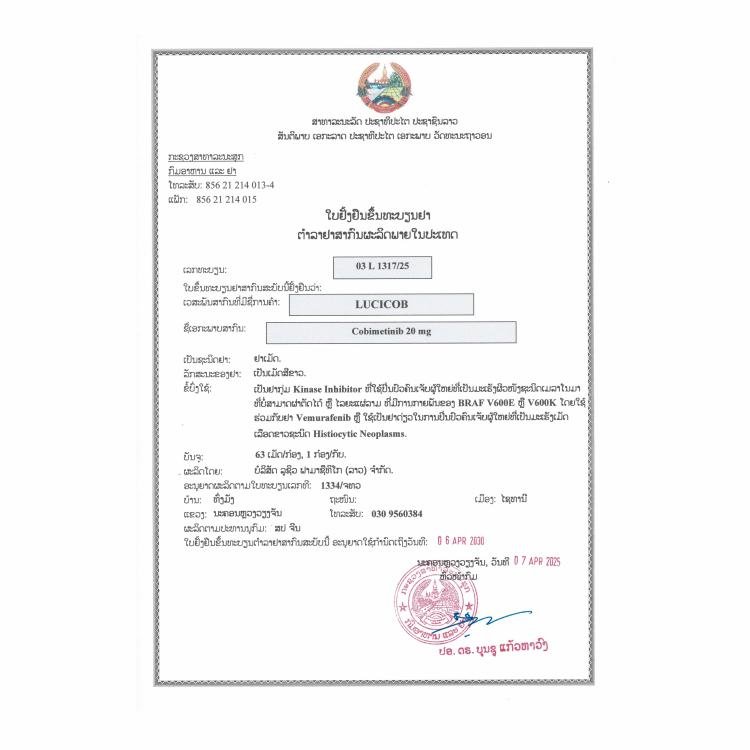
- Product name: Lucicob Cobimetinib 20mg
- Manufacturer / brand: Laos Lucius Pharma
- Active ingredient: Cobimetinib
- Current strength: 20mg
- SKU: LU-ITEM-130
- Site category: BRAF V600E/V600K target, other cancer
Product Summary
Lucicob Cobimetinib 20mg is an AISTIKA-listed product supplied by Laos Lucius Pharma. This page summarizes the product identity, strength, SKU, site category, and public medical reference information. Product name, manufacturer, packaging, and strength follow this AISTIKA product page.
Active Ingredient and Reference Data
Cobimetinib is the active ingredient used for this product page. Public prescribing information for Cobimetinib was used for the medical reference sections. Medical details are provided for reference and must be interpreted by a qualified healthcare professional.
Mechanism of Action
Cobimetinib is a reversible inhibitor of mitogen-activated protein kinase (MAPK)/extracellular signal regulated kinase 1 (MEK1) and MEK2. MEK proteins are upstream regulators of the extracellular signal-related kinase (ERK) pathway, which promotes cellular proliferation. BRAF V600E and K mutations result in constitutive activation of the BRAF pathway which includes MEK1 and MEK2. Cobimetinib and vemurafenib target two different kinases in the RAS/RAF/MEK/ERK pathway.
Reference Indications
Cobimetinib ® is a kinase inhibitor indicated: For the treatment of adult patients with unresectable or metastatic melanoma with a BRAF V600E or V600K mutation, in combination with vemurafenib. ( 1.1 , 14.1 ) As a single agent for the treatment of adult patients with histiocytic neoplasms. ( 1.2 , 14.2 ) 1.1 Unresectable or Metastatic Melanoma Cobimetinib ® is indicated for the treatment of adult patients with unresectable or metastatic melanoma with a BRAF V600E or V600K mutation, in combination with vemurafenib.
Reference Dosage and Administration
Recommended dose is 60 mg orally once daily for the first 21 days of each 28-day cycle until disease progression or unacceptable toxicity. Take Cobimetinib with or without food.
With this 20mg product, that corresponds to 3 x 20mg tablets when that reference dose is clinically appropriate.
This reference dosage is not an individualized prescription. Dose changes, treatment interruptions, or discontinuation must be directed by a physician.
Important Safety Information
Review the for vemurafenib for information on the serious risks of vemurafenib. New primary malignancies, cutaneous and non-cutaneous : Monitor patients for new malignancies prior to initiation of therapy, while on therapy, and for up to 6 months following the last dose of Cobimetinib. Hemorrhage : Major hemorrhagic events can occur with Cobimetinib. Monitor for signs and symptoms of bleeding. ( 5.2 , 2.3 ) Cardiomyopathy : The risk of cardiomyopathy is increased in patients receiving Cobimetinib with vemurafenib compared with vemurafenib as a single agent. The safety of Cobimetinib has not been established in patients with decreased left ventricular ejection fraction (LVEF). Evaluate LVEF before treatment, after one month of treatment, then every 3 months thereafter during treatment with Cobimetinib.
Common Adverse Reactions and Monitoring
The most common (≥5%) Grade 3-4 laboratory abnormalities are increased GGT, increased CPK, hypophosphatemia, increased ALT, lymphopenia, increased AST, increased alkaline phosphatase, hyponatremia. The most common (≥5%) grade 3-4 lab abnormalities include: Hyponatremia, increased blood creatine phosphokinase, hypokalemia, increased blood creatinine, increased AST, hypocalcemia, lymphopenia, leukopenia, anemia Unresectable or Metastatic Melanoma The safety of Cobimetinib was evaluated in Trial 1, a randomized (1:1), double-blind, active-controlled trial in previously untreated patients with BRAF V600 mutation-positive, unresectable or metastatic melanoma .
Drug Interactions and Special Populations
Avoid concomitant administration of Cobimetinib with strong or moderate CYP3A inducers or inhibitors. ( 2.3 , 7.1 , 7.2 ) 7.1 Effect of Strong or Moderate CYP3A Inhibitors on Cobimetinib Coadministration of Cobimetinib with itraconazole (a strong CYP3A4 inhibitor) increased cobimetinib systemic exposure by 6.7-fold. Avoid concurrent use of Cobimetinib and strong or moderate CYP3A inhibitors. If concurrent short term (14 days or less) use of moderate CYP3A inhibitors including certain antibiotics (e.g., erythromycin, ciprofloxacin) is unavoidable for patients who are taking Cobimetinib 60 mg, reduce Cobimetinib dose to 20 mg. After discontinuation of a moderate CYP3A inhibitor, resume Cobimetinib at the previous dose .
Storage and Purchase Notes
Store according to the package or pharmacist instructions and keep out of reach of children. Before ordering, confirm product name, strength, quantity, price, shipping details, and payment method. After receipt, check packaging, batch number, expiration date, and storage conditions.
Sources
Sources: Cotellic public prescribing information; openFDA/DailyMed public label data. These sources are used for public medical reference. Product information follows this AISTIKA product page.
DisclaimerProduct details, availability, pricing, and checkout information can change. Please review this product page carefully and consult a qualified healthcare professional before using any medicine.
Reviews
There are no reviews yet.