
Product Details
Product Information
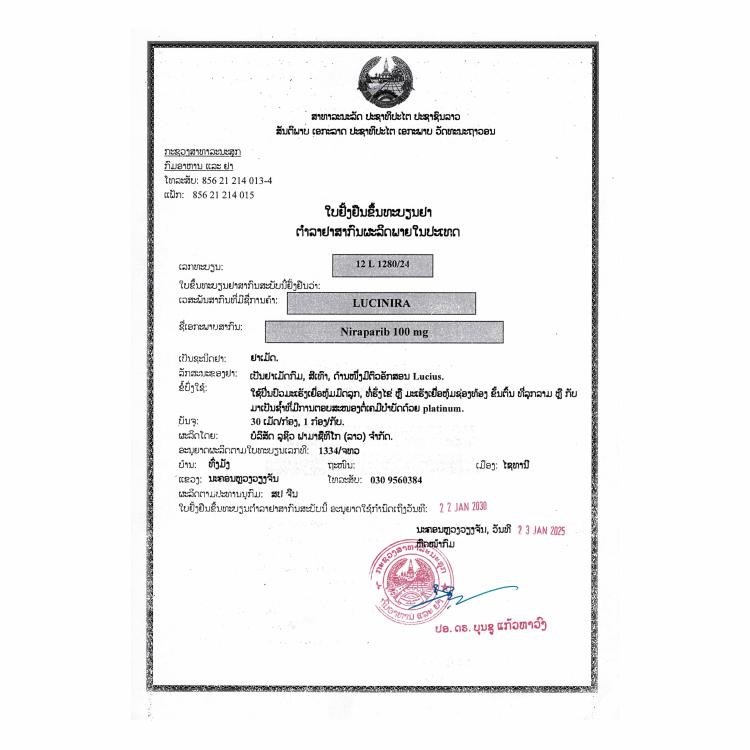
- Product name: LuciNira Niraparib 100mg
- Manufacturer / brand: Laos Lucius Pharma
- Active ingredient: Niraparib
- Current strength: 100mg
- SKU: LU-ITEM-80
- Site category: BRCA target, other cancer
Product Summary
LuciNira Niraparib 100mg is an AISTIKA-listed product supplied by Laos Lucius Pharma. This page summarizes the product identity, strength, SKU, site category, and public medical reference information. Product name, manufacturer, packaging, and strength follow this AISTIKA product page.
Active Ingredient and Reference Data
Niraparib is the active ingredient used for this product page. Public prescribing information for Niraparib was used for the medical reference sections. Medical details are provided for reference and must be interpreted by a qualified healthcare professional.
Mechanism of Action
Niraparib is an inhibitor of PARP enzymes, including PARP-1 and PARP-2, that play a role in DNA repair. Increased niraparib‑induced cytotoxicity was observed in tumor cell lines with or without deficiencies in BRCA1/2 . Niraparib decreased tumor growth in mouse xenograft models of human cancer cell lines with deficiencies in BRCA1/2 and in human patient‑derived xenograft tumor models with homologous recombination deficiency (HRD) that had either mutated or wild-type BRCA1/2 .
Reference Indications
Niraparib with prednisone is indicated for the treatment of adult patients with deleterious or suspected deleterious BRCA2 -mutated ( BRCA2 m) metastatic castration-sensitive prostate cancer (mCSPC). Niraparib with prednisone is indicated for the treatment of adult patients with deleterious or suspected deleterious BRCA -mutated ( BRCA m) metastatic castration-resistant prostate cancer (mCRPC). Select patients for therapy based on an FDA-approved test for Niraparib . Niraparib is a combination of niraparib, a poly (ADP-ribose) polymerase (PARP) inhibitor, and abiraterone acetate, a CYP17 inhibitor indicated with prednisone for the treatment of adult patients with: deleterious or suspected deleterious BRCA2 -mutated ( BRCA2 m) metastatic castration-sensitive prostate cancer (mCSPC).
Reference Dosage and Administration
Recommended dosage of Niraparib is 200 mg niraparib/1,000 mg abiraterone acetate orally once daily in combination with 5 mg prednisone daily until disease progression or unacceptable toxicity. Take Niraparib on an empty stomach at least one hour before or two hours after food.
With this 100mg product, that corresponds to 2 x 100mg tablets when that reference dose is clinically appropriate.
This reference dosage is not an individualized prescription. Dose changes, treatment interruptions, or discontinuation must be directed by a physician.
Important Safety Information
Myelodysplastic Syndrome/Acute Myeloid Leukemia (MDS/AML) : MDS/AML, including a case with fatal outcome, has been observed in patients treated with Niraparib. Monitor patients for hematological toxicity and discontinue if MDS/AML is confirmed. Myelosuppression: Test complete blood counts weekly for the first month, every two weeks for the next two months, monthly for the remainder of the first year, then every other month, and as clinically indicated. Closely monitor patients whose underlying medical conditions might be compromised by increases in blood pressure, hypokalemia, or fluid retention. Control hypertension and correct hypokalemia before and during treatment with Niraparib. Hepatotoxicity: Can be severe and fatal. Monitor liver function and modify, interrupt, or discontinue treatment as recommended.
Common Adverse Reactions and Monitoring
BRCA2 -mutated Metastatic Castration-Sensitive Prostate Cancer (mCSPC) The safety of Niraparib in patients with BRCA2 m mCSPC was evaluated in AMPLITUDE . Patients were randomized to receive either Niraparib (niraparib 200 mg and abiraterone acetate 1,000 mg once daily) (n=162), or placebo and abiraterone acetate (n=161) until unacceptable toxicity or progression. Patients in both arms also received prednisone 5 mg daily. The median duration of exposure for Niraparib was 26 months (range: 0 to 48 months). Permanent discontinuation of any component of Niraparib due to an adverse reaction occurred in 13% of patients.
Drug Interactions and Special Populations
Strong CYP3A4 Inducers: Avoid coadministration. CYP2D6 Substrates: Avoid coadministration of Niraparib with CYP2D6 substrates for which minimal changes in concentration may lead to serious toxicities. If alternative treatments cannot be used, consider a dose reduction of the concomitant CYP2D6 substrate. Abiraterone is a substrate of CYP3A4. Strong CYP3A4 inducers may decrease abiraterone concentrations , which may reduce the effectiveness of abiraterone. If alternative treatments cannot be used, consider a dose reduction of the concomitant CYP2D6 substrate drug. Abiraterone is a CYP2D6 moderate inhibitor. Abiraterone is a CYP2C8 inhibitor. Moderate or Severe Hepatic impairment: Avoid use. Based on findings from animal studies and mechanism of action , Niraparib can cause fetal harm and potential loss of pregnancy.
Storage and Purchase Notes
Store according to the package or pharmacist instructions and keep out of reach of children. Before ordering, confirm product name, strength, quantity, price, shipping details, and payment method. After receipt, check packaging, batch number, expiration date, and storage conditions.
Sources
Sources: AKEEGA public prescribing information; openFDA/DailyMed public label data. These sources are used for public medical reference. Product information follows this AISTIKA product page.
DisclaimerProduct details, availability, pricing, and checkout information can change. Please review this product page carefully and consult a qualified healthcare professional before using any medicine.
Reviews
There are no reviews yet.