
Product Details
Product Information
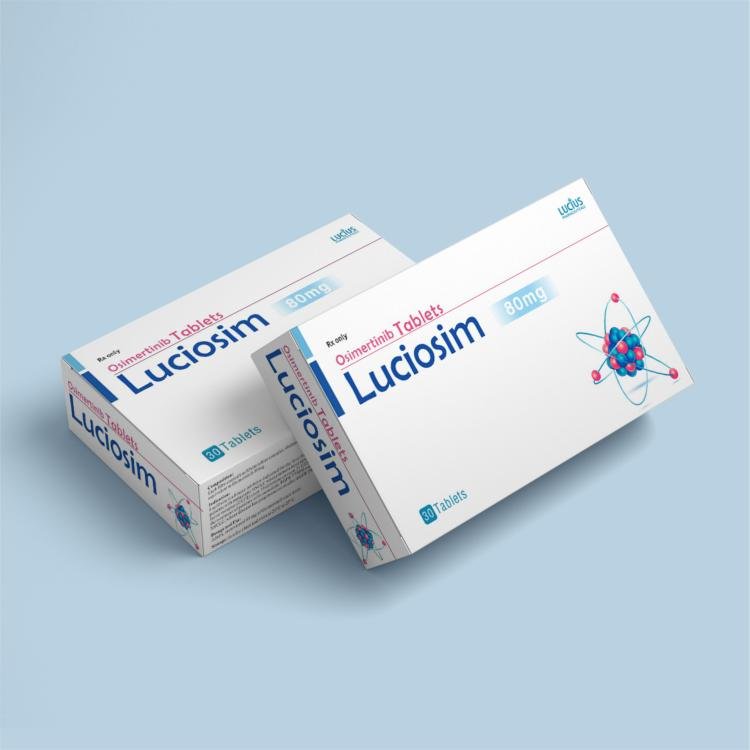
- Product name: LuciOsim Osimertinib as shown on package
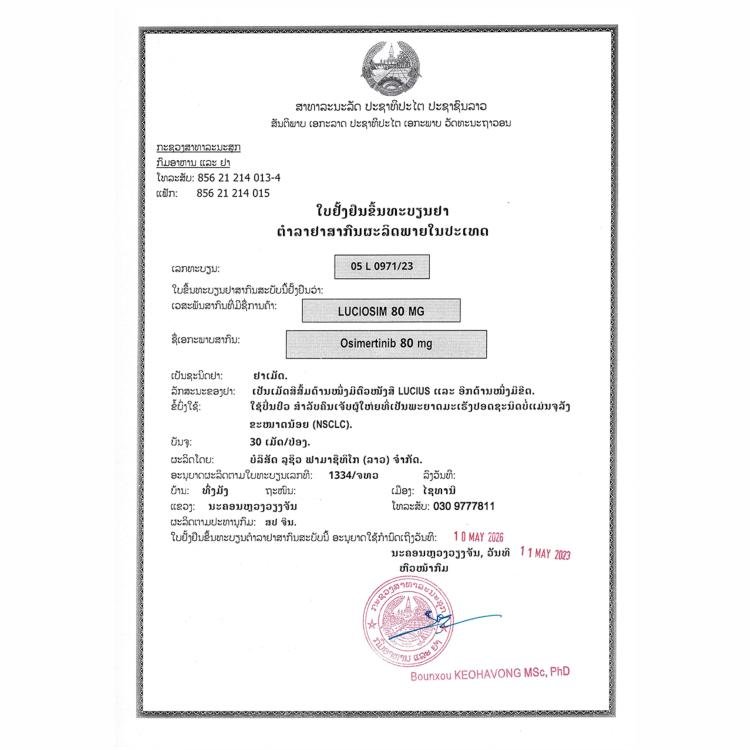
- Manufacturer / brand: Laos Lucius Pharma
- Active ingredient: Osimertinib
- Current strength: as shown on package
- SKU: LU-ITEM-83
- Site category: third-generation EGFR-TKI, other cancer
Product Summary
LuciOsim Osimertinib as shown on package is an AISTIKA-listed product supplied by Laos Lucius Pharma. This page summarizes the product identity, strength, SKU, site category, and public medical reference information. Product name, manufacturer, packaging, and strength follow this AISTIKA product page.
Active Ingredient and Reference Data
Osimertinib is the active ingredient used for this product page. Public prescribing information for Osimertinib was used for the medical reference sections. Medical details are provided for reference and must be interpreted by a qualified healthcare professional.
Mechanism of Action
Osimertinib is a kinase inhibitor of the epidermal growth factor receptor (EGFR), which binds irreversibly to certain mutant forms of EGFR (T790M, L858R, and exon 19 deletions) at approximately 9-fold lower concentrations than wild-type. Two pharmacologically-active metabolites (AZ7550 and AZ5104 circulating at approximately 10% of the parent) with similar inhibitory profiles to osimertinib have been identified in the plasma after oral administration of osimertinib.
Reference Indications
Osimertinib is a kinase inhibitor indicated for: adjuvant therapy after tumor resection in adult patients with non-small cell lung cancer (NSCLC) whose tumors have epidermal growth factor receptor (EGFR) exon 19 deletions or exon 21 L858R mutations, as detected by an FDA-approved test. ( 1.1 , 2.2 ) the treatment of adult patients with locally advanced, unresectable (stage III) NSCLC whose disease has not progressed during or following concurrent or sequential platinum-based chemoradiation therapy and whose tumors have EGFR exon 19 deletions or exon 21 L858R mutations, as detected by an FDA-approved test. ( 1.2 , 2.2 ) the first-line treatment of adult patients with metastatic NSCLC whose tumors have EGFR exon 19 deletions or exon 21 L858R mutations, as detected by an FDA-approved test.
Reference Dosage and Administration
The public label should be checked for the indication-specific recommended dosage. Available administration instructions note that the medicine may be taken recommended dosage of Osimertinib by indication. with or without food, until disease recurrence, or unacceptable toxicity, or for up to 3 years.
Dose conversion must be confirmed by a physician because the reference dose may vary by indication, organ function, toxicity, or interacting medicines.
This reference dosage is not an individualized prescription. Dose changes, treatment interruptions, or discontinuation must be directed by a physician.
Important Safety Information
Interstitial Lung Disease (ILD)/Pneumonitis : Monitor for new or worsening pulmonary symptoms indicative of ILD/pneumonitis. Permanently discontinue Osimertinib in patients diagnosed with Grade ≥2 ILD/pneumonitis. ( 2.5 , 5.1 ) QTc Interval Prolongation : Monitor electrocardiograms and electrolytes in patients who have a history or predisposition for QTc prolongation, or those who are taking medications that are known to prolong the QTc interval. Withhold, then restart at a reduced dose or permanently discontinue Osimertinib based on severity. ( 2.5 , 5.2 ) Cardiomyopathy : Occurred in 3.8% of patients. Conduct cardiac monitoring, including left ventricular ejection fraction (LVEF) assessment in patients with cardiac risk factors.
Common Adverse Reactions and Monitoring
Osimertinib monotherapy following platinum-based chemoradiation therapy: lymphopenia, leukopenia, ILD/pneumonitis, thrombocytopenia, neutropenia, rash, diarrhea, nail toxicity, musculoskeletal pain, cough and COVID-19. Osimertinib in combination with pemetrexed and platinum-based chemotherapy: leukopenia, thrombocytopenia, neutropenia, lymphopenia, rash, diarrhea, stomatitis, nail toxicity, dry skin, and increased blood creatinine.
Drug Interactions and Special Populations
Strong CYP3A Inducers : Avoid concomitant use. If not possible, increase Osimertinib to 160 mg daily in patients receiving a strong CYP3A4 inducer. ( 2.5 , 7.1 ) 7.1 Effect of Other Drugs on Osimertinib Strong CYP3A Inducers Co-administering Osimertinib with a strong CYP3A4 inducer decreased the exposure of osimertinib compared to administering Osimertinib alone . Decreased osimertinib exposure may lead to reduced efficacy. Avoid co-administering Osimertinib with strong CYP3A inducers. Increase the Osimertinib dosage when co-administering with a strong CYP3A4 inducer if concurrent use is unavoidable . No dose adjustments are required when Osimertinib is used with moderate and/or weak CYP3A inducers. Increased BCRP or P-gp substrate exposure may increase the risk of exposure-related toxicity.
Storage and Purchase Notes
Store according to the package or pharmacist instructions and keep out of reach of children. Before ordering, confirm product name, strength, quantity, price, shipping details, and payment method. After receipt, check packaging, batch number, expiration date, and storage conditions.
Sources
Sources: TAGRISSO public prescribing information; openFDA/DailyMed public label data. These sources are used for public medical reference. Product information follows this AISTIKA product page.
DisclaimerProduct details, availability, pricing, and checkout information can change. Please review this product page carefully and consult a qualified healthcare professional before using any medicine.
Reviews
There are no reviews yet.